You Need to Know the Height of a Tower but Darkness Obscures the Ceiling
| Leaning Belfry of Pisa | |
|---|---|
| Torre Pendente di Pisa | |
 Leaning Tower of Pisa in 2013 | |
| Organized religion | |
| Affiliation | Catholic Church |
| Ecclesiastical or organizational status | Active |
| Location | |
| Location | Pisa, Italia |
| Geographic coordinates | 43°43′23″North 10°23′47″E / 43.72306°Due north 10.39639°E / 43.72306; 10.39639 Coordinates: 43°43′23″Northward ten°23′47″Eastward / 43.72306°N 10.39639°Eastward / 43.72306; ten.39639 |
| Architecture | |
| Builder(s) | Bonanno Pisano |
| Style | Romanesque |
| Groundbreaking | 1173 |
| Completed | 1372 |
| Specifications | |
| Elevation (max) | 55.86 grand (183 ft 3 in) |
| Materials |
|
| Website | |
| world wide web | |
| UNESCO World Heritage Site | |
| Part of | Piazza del Duomo, Pisa |
| Criteria | Cultural: i, two, iv, vi |
| Reference | 395 |
| Inscription | 1987 (11th Session) |
The Leaning Tower of Pisa (Italian: torre pendente di Pisa), or just the Tower of Pisa (torre di Pisa [ˈtorre di ˈpiːza; ˈpiːsa] [1]), is the campanile, or freestanding bell tower, of the cathedral of the Italian city of Pisa, known worldwide for its nearly 4-degree lean, the issue of an unstable foundation. The tower is situated behind the Pisa Cathedral and is the third-oldest structure in the metropolis'southward Cathedral Square (Piazza del Duomo), afterward the cathedral and the Pisa Baptistry.
The height of the tower is 55.86 metres (183 feet iii inches) from the footing on the low side and 56.67 m (185 ft 11 in) on the loftier side. The width of the walls at the base of operations is ii.44 chiliad (8 ft 0 in). Its weight is estimated at 14,500 tonnes (16,000 brusk tons).[2] The belfry has 296 or 294 steps; the 7th floor has two fewer steps on the north-facing staircase.
The tower began to lean during construction in the 12th century, due to soft ground which could not properly support the construction's weight, and it worsened through the completion of construction in the 14th century. By 1990, the tilt had reached 5.5 degrees.[iii] [iv] [5] The construction was stabilized past remedial work between 1993 and 2001, which reduced the tilt to 3.97 degrees.[6]
Builder
There has been controversy about the real identity of the architect of the Leaning Tower of Pisa. For many years, the design was attributed to Guglielmo and Bonanno Pisano,[7] a well-known 12th-century resident artist of Pisa, known for his statuary casting, particularly in the Pisa Duomo. Pisano left Pisa in 1185 for Monreale, Sicily, only to come back and dice in his home town. A piece of cast begetting his name was discovered at the foot of the tower in 1820, but this may be related to the bronze door in the façade of the cathedral that was destroyed in 1595. A 2001 study seems to indicate Diotisalvi was the original builder, due to the time of construction and analogousness with other Diotisalvi works, notably the bong tower of San Nicola and the Baptistery, both in Pisa.[8] [ page needed ]
-
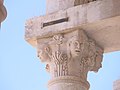
Column capital details on top level
-
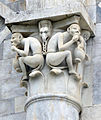
Cavalcade details
-

Base wall columns
-
Flower pendant
-

Entrance
-

Wall relief details of animals
-

Outer floor tiles
-

Assunta bell
-

Pasquareccia bell
-

Top-level bells
Structure
Construction of the tower occurred in iii stages over 199 years. On 5 January 1172, Donna Berta di Bernardo, a widow and resident of the house of dell'Opera di Santa Maria, bequeathed lx soldi to the Opera Campanilis petrarum Sancte Marie . The sum was then used toward the purchase of a few stones which nevertheless class the base of the bong tower.[ix] On 9 August 1173, the foundations of the tower were laid.[x] Work on the ground floor of the white marble campanile began on 14 August of the same year during a flow of military success and prosperity. This ground floor is a blind arcade articulated by engaged columns with classical Corinthian capitals.[ commendation needed ] Nearly four centuries afterward Giorgio Vasari wrote: "Guglielmo, co-ordinate to what is being said, in the twelvemonth 1174, together with sculptor Bonanno, laid the foundations of the bell belfry of the cathedral in Pisa".[eleven]
The belfry began to sink after structure had progressed to the second flooring in 1178. This was due to a mere 3-metre foundation, set in weak, unstable subsoil, a pattern that was flawed from the start. Construction was after halted for almost a century, as the Republic of Pisa was nearly continually engaged in battles with Genoa, Lucca, and Florence. This allowed time for the underlying soil to settle. Otherwise, the tower would almost certainly have toppled.[12] On 27 December 1233, the worker Benenato, son of Gerardo Bottici, oversaw the continuation of the belfry's construction.[thirteen]
On 23 February 1260, Guido Speziale, son of Giovanni Pisano, was elected to oversee the building of the tower.[fourteen] On 12 April 1264, the master builder Giovanni di Simone, builder of the Camposanto, and 23 workers went to the mountains close to Pisa to cutting marble. The cut stones were given to Rainaldo Speziale, worker of St. Francesco.[15] In 1272, construction resumed nether Di Simone. In an endeavour to compensate for the tilt, the engineers built upper floors with one side taller than the other. Because of this, the belfry is curved.[xvi] Construction was halted over again in 1284 when the Pisans were defeated past the Genoese in the Battle of Meloria.[x] [17]
The seventh flooring was completed in 1319.[18] The bell-chamber was finally added in 1372. It was built past Tommaso di Andrea Pisano, who succeeded in harmonizing the Gothic elements of the belfry with the Romanesque style of the tower.[19] [xx] There are 7 bells, ane for each note of the musical major scale. The largest i was installed in 1655.[12]

History following construction
Betwixt 1589 and 1592,[21] Galileo Galilei, who lived in Pisa at the time, is said to have dropped two cannonballs of dissimilar masses from the tower to demonstrate that their speed of descent was contained of their mass, in keeping with the constabulary of complimentary autumn. The primary source for this is the biography Racconto istorico della vita di Galileo Galilei (Historical Account of the Life of Galileo Galilei), written by Galileo'southward student and secretary Vincenzo Viviani in 1654, but only published in 1717, long later on his death.[22] [23]
During Globe State of war II, the Allies suspected that the Germans were using the tower every bit an observation post. Leon Weckstein, a U.S. Army sergeant sent to confirm the presence of German troops in the belfry, was impressed by the beauty of the cathedral and its campanile, and thus refrained from ordering an arms strike, sparing it from destruction.[24] [ page needed ] [25]
Numerous efforts take been made to restore the tower to a vertical orientation or at least keep it from falling over. Near of these efforts failed; some worsened the tilt. On 27 February 1964, the government of Italy requested aid in preventing the tower from toppling. It was, notwithstanding, considered important to retain the current tilt, due to the role that this element played in promoting the tourism manufacture of Pisa.[26]
Starting in 1993, 870 tonnes of lead counterweights were added, which straightened the belfry slightly.[27]
The tower and the neighbouring cathedral, baptistery, and cemetery are included in the Piazza del Duomo UNESCO Earth Heritage Site, which was declared in 1987.[28]
The tower was closed to the public on vii Jan 1990,[29] later more than 2 decades of stabilisation studies and spurred by the abrupt collapse of the Civic Tower of Pavia in 1989.[30] [31] The bells were removed to relieve some weight, and cables were cinched around the tertiary level and anchored several hundred meters abroad. Apartments and houses in the path of a potential fall of the tower were vacated for safety. The selected method for preventing the collapse of the tower was to slightly reduce its tilt to a safer angle by removing 38 cubic metres (1,342 cubic feet) of soil from underneath the raised end. The tower'south tilt was reduced by 45 centimetres (17+ 1⁄ii inches), returning to its 1838 position. After a decade of corrective reconstruction and stabilization efforts, the belfry was reopened to the public on 15 December 2001, and was declared stable for at least some other 300 years.[27] In total, seventy metric tons (77 short tons) of soil were removed.[32]
Later a phase (1990–2001) of structural strengthening,[33] the tower has been undergoing gradual surface restoration to repair visible impairment, mostly corrosion and blackening. These are particularly pronounced due to the tower's age and its exposure to wind and rain.[34] In May 2008, engineers announced that the tower had been stabilized such that information technology had stopped moving for the first fourth dimension in its history. They stated that it would be stable for at least 200 years.[32]
-

Leaning Tower of Pisa in the 1890s[35]
-

Temporary atomic number 82 counterweights, 1998
Convulsion survival
At least iv potent earthquakes have hitting the region since 1280, but the apparently vulnerable Tower survived. The reason was non understood until a research group of 16 engineers investigated. The researchers concluded that the Tower was able to withstand the tremors considering of dynamic soil-structure interaction (DSSI): the height and stiffness of the Tower, together with the softness of the foundation soil, influences the vibrational characteristics of the structure in such a style that the Belfry does not resonate with earthquake ground motion. The same soft soil that caused the leaning and brought the Belfry to the verge of plummet helped it survive.[36]
Technical data
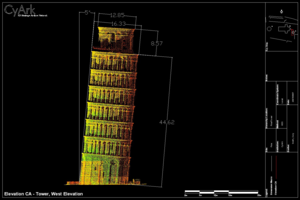
An elevation paradigm of the Leaning Tower of Pisa cut with light amplification by stimulated emission of radiation scan data from a University of Ferrara/CyArk enquiry partnership, with source image accurate down to
5 mm ( 3⁄16 in).
- Elevation of Piazza del Duomo: near 2 metres (6 feet, DMS)
- Tiptop from the ground flooring: 55.863 m (183 ft 3+ 5⁄16 in),[37] 8 stories[38]
- Peak from the foundation floor: 58.36 one thousand (191 ft five+ ane⁄ii in)[39]
- Outer diameter of base: 15.484 g (50 ft 9+ 5⁄8 in)[37]
- Inner diameter of base: 7.368 yard (24 ft 2+ ane⁄xvi in)[37]
- Bending of slant: iii.97 degrees[40] or 3.9 m (12 ft 10 in) from the vertical[41]
- Weight: fourteen,700 metric tons (16,200 short tons)[42]
- Thickness of walls at the base: ii.44 m (8 ft 0 in)
- Total number of bells: 7, tuned to musical scale,[43] clockwise:[ citation needed ]
- 1st bell: L'Assunta, cast in 1654 past Giovanni Pietro Orlandi, weight 3,620 kg (7,981 lb)
- second bell: Il Crocifisso, cast in 1572 by Vincenzo Possenti, weight 2,462 kg (v,428 lb)
- 3rd bell: San Ranieri, cast in 1719–1721 past Giovanni Andrea Moreni, weight 1,448 kg (3,192 lb)
- 4th bell: La Terza (1st small ane), cast in 1473, weight 300 kg (661 lb)
- 5th bell: La Pasquereccia or La Giustizia, bandage in 1262[44] by Lotteringo, weight i,014 kg (2,235 lb)
- sixth bong: Il Vespruccio (second small one), cast in the 14th century and once again in 1501 past Nicola di Jacopo, weight 1,000 kg (2,205 lb)
- 7th bong: Dal Pozzo, cast in 1606 and once more in 2004, weight 652 kg (one,437 lb)[45]
- Number of steps to the peak: 296[46]
Virtually the 5th bong: The name Pasquareccia comes from Easter, because it used to ring on Easter day. However, this bell is older than the bell-chamber itself, and comes from the tower Vergata in Palazzo Pretorio in Pisa, where it was called La Giustizia (The Justice). The bell was tolled to announce executions of criminals and traitors, including Count Ugolino in 1289.[47] A new bell was installed in the bong tower at the terminate of the 18th century to supersede the broken Pasquareccia.[ citation needed ]
The round shape and neat peak of the campanile were unusual for their fourth dimension, and the crowning belfry is stylistically distinct from the rest of the construction. This belfry incorporates a 14 cm (five+ i⁄2 in) correction for the inclined axis below. The siting of the campanile inside the Piazza del Duomo diverges from the centric alignment of the cathedral and baptistery of the Piazza del Duomo.[ commendation needed ]
Guinness World Records
Two High german churches accept challenged the belfry's condition as the world's most lopsided edifice: the 15th-century square Leaning Tower of Suurhusen and the 14th-century bong tower in the town of Bad Frankenhausen.[48] Guinness World Records measured the Pisa and Suurhusen towers, finding the sometime's tilt to be 3.97 degrees.[40] In June 2010, Guinness Earth Records certified the Capital Gate building in Abu Dhabi, UAE as the "World's Furthest Leaning Man-made Tower";[49] information technology has an 18-degree slope, well-nigh 5 times more than the Pisa Tower, simply was deliberately engineered to slant. The Leaning Tower of Wanaka in New Zealand, also deliberately built, leans at 53 degrees to the ground.[50]
Gallery
-

View looking up
-
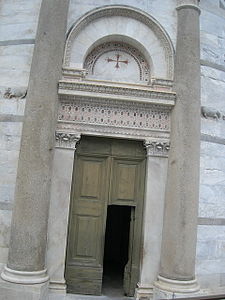
Entrance door to the bell tower
-

-

Inner staircase from 6th to seventh floor
-
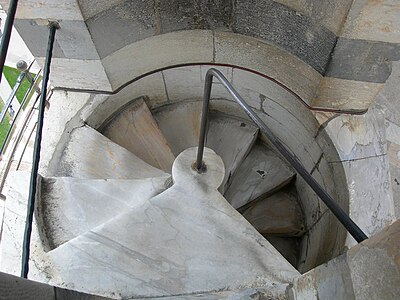
Inner staircase from seventh to eighth (the peak) floor
-

View from the acme
-

View, looking downwardly from the tiptop
-
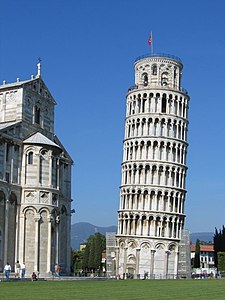
Leaning Tower of Pisa in 2004
-

Tourist in a common pose at Tower of Pisa, June 2009
See also
- Leaning Temple of Huma
- List of leaning towers
- Leaning Tower of Niles, a replica of the Tower of Pisa
- Leaning Tower of Zaragoza, was a famous European leaning tower
- Great Mosque of al-Nuri (Mosul), an ancient leaning tower that stood until 2017; reconstruction efforts are currently underway
- Circular tower (disambiguation), for other types of round towers
- The Greyfriars Tower, the remains of a Franciscan monastery in King'due south Lynn, nicknamed "The Leaning Tower of Lynn"
- Torre delle Milizie, a tilting medieval belfry in Rome
- Bout de Pise, a stone dome in Antarctica, was named after this belfry
References
- ^ "DiPI Online". Dizionario di Pronuncia Italiana (in Italian). Archived from the original on 30 Oct 2020. Retrieved 26 December 2020.
- ^ "Leaning Belfry of Pisa Facts". Leaning Belfry of Pisa. Archived from the original on eleven September 2013. Retrieved 5 October 2013.
- ^ "Europe | Saving the Leaning Belfry". BBC News. 15 December 2001. Archived from the original on 21 September 2013. Retrieved 9 May 2009.
- ^ "Tower of Pisa". Archidose.org. 17 June 2001. Archived from the original on 26 June 2009. Retrieved 9 May 2009.
- ^ "Leaning Tower of Pisa (tower, Pisa, Italy) – Britannica Online Encyclopedia". Britannica.com. Archived from the original on 8 March 2013. Retrieved 9 May 2009.
- ^ "Leaning belfry of Pisa loses kleptomaniacal crown". Irish News. Archived from the original on 28 November 2020. Retrieved 10 June 2020.
- ^ "Endex.com". www.endex.com. Archived from the original on 13 August 2007.
- ^ Pierotti, Piero. (2001). Deotisalvi – 50'architetto pisano del secolo d'oro. Pisa: Pacini Editore
- ^ Capitular Record Offices of Pisa, parchment north. 248
- ^ a b Potts, David M.; Zdravkovic, Lidija; Zdravković, Lidija (2001). Finite Element Analysis in Geotechnical Engineering: Awarding. Thomas Telford. p. 254. ISBN9780727727831. Archived from the original on 18 September 2019. Retrieved 5 August 2019.
- ^ Vasari, Giorgio (1878). Le opere di Giorgio Vasari: Le vite de' più eccellenti pittori, scultori ed architettori (in Italian). 1000.C. Sansoni. pp. 274. OCLC 15220635.
Guglielmo, secondo che si dice, l'anno 1174, insieme con Bonanno scultore, fondò in Pisa il campanile del Duomo, dove sono alcune parole
- ^ a b "Fall of the Leaning Tower – History of Interventions". NOVA Online (PBS). 1999. Archived from the original on 24 April 2019. Retrieved 24 Apr 2019.
- ^ Public Record Offices of Pisa, Opera della Primaziale, 27 December 1234
- ^ Public Record Offices of Pisa, Opera della Primaziale, 23 February 1260
- ^ Public Record Offices of Pisa, Roncioni, 12 April 1265.
- ^ McLain, Beak (1999). Practise Fish Drink H2o? . New York: William Morrow and Company, Inc. pp. 291–292. ISBN0-688-16512-5.
- ^ Touring guild italiano (2005). Authentic Tuscany. Touring Editore. p. 64. ISBN9788836532971. Archived from the original on 9 August 2021. Retrieved 5 August 2019.
- ^ Roth, Leland Chiliad. (xiii March 2018). Understanding Architecture: Its Elements, History, and Meaning. Routledge. p. 98. ISBN9780429975219. Archived from the original on 9 August 2021. Retrieved 5 Baronial 2019.
- ^ G. Barsali (1999), Pisa. History and masterpieces, Bonechi, p. xviii, ISBN8872041880, archived from the original on ix August 2021, retrieved 25 August 2015
- ^ Giorgio Vasari, Jean Paul Richter (1855), Lives of the Most Eminent Painters, Sculptors, and Architects, H. G. Bohn, p. 153, archived from the original on 9 August 2021, retrieved 14 November 2020
- ^ Some contemporary sources speculate about the exact appointment; eastward.thou. Rachel Hilliam gives 1591 (Galileo Galilei: Father of Modern Science, The Rosen Publishing Group, 2005, p. 101).
- ^ "Sci Tech : Science history: setting the record straight". The Hindu. 30 June 2005. Archived from the original on 2 November 2005. Retrieved 5 May 2009.
- ^ Vincenzo Viviani Archived six Feb 2016 at the Wayback Machine on museo galileo
- ^ Shrady, Nicholas (2003): Tilt: a skewed history of the Tower of Pisa
- ^ "Why I spared the Leaning Tower of Pisa". The Guardian. 12 Jan 2000. Archived from the original on 9 May 2014. Retrieved xix July 2012.
- ^ "Securing the Lean In Tower of Pisa". The New York Times. 1 November 1987. Archived from the original on xiv February 2009. Retrieved 17 February 2017.
- ^ a b "Tipping the Balance". Fourth dimension Magazine. 25 June 2001. Archived from the original on 23 November 2020. Retrieved 30 May 2020.
- ^ "Piazza del Duomo, Pisa". UNESCO World Heritage Centre. Archived from the original on ii September 2016. Retrieved viii August 2016.
- ^ "BBC on this 24-hour interval: 1990: Leaning Tower of Pisa closed to public". BBC News. Archived from the original on 20 February 2020. Retrieved 29 April 2020.
- ^ Hofman, Paul (30 July 1989). "Italian republic's Endangered Treasures". New York Times. New York. Archived from the original on 9 Nov 2020. Retrieved 29 Apr 2020.
- ^ Montalbo, William D (18 March 1989). "900-Year-Old Bell Belfry Collapses in Italy; Iii Killed". Los Angeles Times. Los Angeles. Archived from the original on 30 November 2020. Retrieved 29 Apr 2020.
- ^ a b Duff, Mark (28 May 2008). "Europe | Pisa'south leaning tower 'stabilised'". BBC News. Archived from the original on 20 April 2013. Retrieved 5 May 2009.
- ^ A contour of an engineer employed to straighten the belfry Archived 27 January 2012 at the Wayback Machine Ingenia, March 2005
- ^ "Restoration work is mentioned at the official website of the square". Archived from the original on 25 October 2009. Retrieved 14 May 2007.
- ^ Tom (6 May 2015). "Leaning Tower of Pisa in the 1890s". Absurd Old Photos. Archived from the original on 6 March 2019. Retrieved 5 March 2019.
- ^ "500-year-erstwhile Leaning Tower of Pisa mystery unveiled by engineers". ScienceDaily. nine May 2018. Archived from the original on 22 November 2018. Retrieved 22 November 2018.
- ^ a b c "2051?". The Michigan Architect and Engineer. 27: 17. 1952. Archived from the original on 2 July 2020. Retrieved 5 August 2019.
- ^ Burland, J.B. (2008). "Stabilising the Leaning Tower of Pisa: the Development of Geotechnical Solutions". Trans. Newcomen Soc. 78 (ii): 174. doi:10.1179/175035208X317657. ISSN 0372-0187. S2CID 110178919.
- ^ Valdes, Giuliano (1994). Art and History of Pisa. Casa Editrice Bonechi. p. 44. ISBN9788880290247. Archived from the original on 9 August 2021. Retrieved 5 August 2019.
- ^ a b "German steeple beats Leaning Tower of Pisa into Guinness book". Tendency News Agency. AFP. 9 November 2007. Archived from the original on 4 May 2009.
- ^ tan(3.97 degrees) * (55.86m + 56.70m)/2 = 3.9m
- ^ Strom, Steven; Nathan, Kurt; Woland, Jake; Lamm, David (28 September 2009). Site Engineering for Landscape Architects. John Wiley and Sons. p. 124. ISBN9780471695493. Archived from the original on nine August 2021. Retrieved 5 August 2019.
- ^ Black, William Harman (1920). The Real Europe Pocket Guide-book: Number 10 of the 'Black'south Blue Books' . Brentanos. pp. 360. OCLC 316943604.
- ^ Black, Charles Bertram (1898). The Riviera, Or The Declension from Marseilles to Leghorn: Including the Interior Towns of Carrara, Lucca, Pisa and Pistoia. A. & C. Black. pp. 148. OCLC 18806463.
- ^ "Leaning Tower of Pisa: 1920s Photo of Dal Pozzo". www.endex.com. Archived from the original on 18 April 2010. Retrieved ix August 2010.
- ^ Davies, Andrew (2005). The Children's Visual Earth Atlas. Sydney, Australia: The Fog Printing. ISBN1-74089-317-four.
- ^ "Torre pendente" (in Italian). Lucca turismo. Archived from the original on 8 April 2008. Retrieved nineteen March 2008.
- ^ Dominicus Telegraph no. two,406, 22 July 2007
- ^ "Not and so fast, Pisa! UAE lays claim to world'south furthest leaning tower". CNN news. 7 June 2010. Archived from the original on eight June 2010. Retrieved 6 June 2010.
- ^ 'Leaning and tumbling towers' Archived xxx July 2011 at the Wayback Machine on Puzzling World website, viewed 30 July 2011
External links
- Opera della Primaziale Pisana —official site (in English and Italian)
- Piazza dei Miracoli digital media archive (Artistic Commons–licensed photos, laser scans, panoramas), data from a University of Ferrara/CyArk research partnership, includes 3D scan data from Leaning Tower.
- Leaning Tower of Pisa at Structurae
Source: https://en.wikipedia.org/wiki/Leaning_Tower_of_Pisa

Post a Comment for "You Need to Know the Height of a Tower but Darkness Obscures the Ceiling"