Study Shows Costs of Living for Working Families Leveling Off in Pa

Art history is the study of artful objects and visual expression in historical and stylistic context.[i] Traditionally, the discipline of art history emphasized painting, drawing, sculpture, compages, ceramics and decorative arts, yet today, art history examines broader aspects of visual civilisation, including the various visual and conceptual outcomes related to an e'er-evolving definition of fine art.[2] [three] Art history encompasses the report of objects created by unlike cultures around the world and throughout history that convey meaning, importance or serve usefulness primarily through visual representations.
As a subject, art history is distinguished from art criticism, which is concerned with establishing a relative artistic value upon individual works with respect to others of comparable style or sanctioning an entire mode or movement; and art theory or "philosophy of art", which is concerned with the fundamental nature of fine art. One co-operative of this area of written report is aesthetics, which includes investigating the enigma of the sublime and determining the essence of dazzler. Technically, art history is not these things, considering the art historian uses historical method to answer the questions: How did the creative person come up to create the piece of work?, Who were the patrons?, Who were their teachers?, Who was the audience?, Who were their disciples?, What historical forces shaped the creative person's oeuvre and how did he or she and the creation, in plow, affect the course of artistic, political and social events? It is, however, questionable whether many questions of this kind can be answered satisfactorily without also considering basic questions nearly the nature of art. The current disciplinary gap between fine art history and the philosophy of art (aesthetics) often hinders this enquiry.[four]
Methodologies [edit]
Art history is an interdisciplinary exercise that analyzes the diverse factors—cultural, political, religious, economic or artistic—which contribute to visual appearance of a work of art.
Art historians use a number of methods in their research into the ontology and history of objects.
Art historians oftentimes examine work in the context of its time. At best, this is done in a manner which respects its creator's motivations and imperatives; with consideration of the desires and prejudices of its patrons and sponsors; with a comparative analysis of themes and approaches of the creator's colleagues and teachers; and with consideration of iconography and symbolism. In short, this approach examines the work of art in the context of the earth within which it was created.
Art historians as well often examine work through an analysis of course; that is, the creator's use of line, shape, color, texture and composition. This approach examines how the artist uses a two-dimensional pic aeroplane or the three dimensions of sculptural or architectural space to create their art. The way these private elements are employed results in representational or non-representational art. Is the artist imitating an object or tin can the prototype be found in nature? If and so, it is representational. The closer the fine art hews to perfect imitation, the more the fine art is realistic. Is the artist not imitating, only instead relying on symbolism or in an of import mode striving to capture nature'south essence, rather than re-create information technology straight? If so the art is non-representational—also called abstract. Realism and abstraction exist on a continuum. Impressionism is an example of a representational style that was not directly imitative, but strove to create an "impression" of nature. If the work is not representational and is an expression of the artist's feelings, longings and aspirations or is a search for ideals of beauty and form, the piece of work is non-representational or a work of expressionism.
An iconographical analysis is one which focuses on item design elements of an object. Through a close reading of such elements, it is possible to trace their lineage, and with information technology draw conclusions regarding the origins and trajectory of these motifs. In turn, information technology is possible to make whatever number of observations regarding the social, cultural, economic and aesthetic values of those responsible for producing the object.
Many art historians apply critical theory to frame their inquiries into objects. Theory is most often used when dealing with more recent objects, those from the late 19th century onward. Critical theory in art history is often borrowed from literary scholars and it involves the application of a non-creative belittling framework to the study of art objects. Feminist, Marxist, disquisitional race, queer and postcolonial theories are all well established in the subject. Every bit in literary studies, in that location is an interest among scholars in nature and the environment, but the direction that this will take in the discipline has however to be determined.
Timeline of prominent methods [edit]
Pliny the Elder and ancient precedents [edit]
The primeval surviving writing on art that can exist classified equally fine art history are the passages in Pliny the Elder's Natural History (c. AD 77-79), concerning the evolution of Greek sculpture and painting.[v] From them it is possible to trace the ideas of Xenokrates of Sicyon (c. 280 BC), a Greek sculptor who was perhaps the first art historian.[vi] Pliny's piece of work, while mainly an encyclopaedia of the sciences, has thus been influential from the Renaissance onwards. (Passages nearly techniques used by the painter Apelles c. (332-329 BC), accept been especially well-known.) Similar, though independent, developments occurred in the 6th century China, where a canon of worthy artists was established by writers in the scholar-official grade. These writers, being necessarily proficient in calligraphy, were artists themselves. The artists are described in the 6 Principles of Painting formulated past Xie He.[7]
Vasari and artists' biographies [edit]
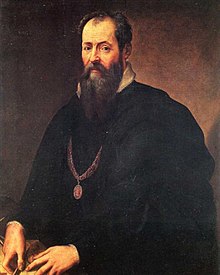

While personal reminiscences of art and artists take long been written and read (run into Lorenzo Ghiberti Commentarii, for the best early instance),[8] it was Giorgio Vasari, the Tuscan painter, sculptor and author of the Lives of the Most First-class Painters, Sculptors, and Architects, who wrote the kickoff true history of art.[9] He emphasized art'south progression and evolution, which was a milestone in this field. His was a personal and a historical account, featuring biographies of individual Italian artists, many of whom were his contemporaries and personal acquaintances. The about renowned of these was Michelangelo, and Vasari'southward business relationship is enlightening, though biased[ commendation needed ] in places.
Vasari'south ideas virtually art were enormously influential, and served as a model for many, including in the north of Europe Karel van Mander's Schilder-boeck and Joachim von Sandrart'southward Teutsche Akademie.[ citation needed ] Vasari's approach held sway until the 18th century, when criticism was leveled at his biographical business relationship of history.[ citation needed ]
Winckelmann and art criticism [edit]
Scholars such equally Johann Joachim Winckelmann (1717–1768), criticized Vasari'due south "cult" of artistic personality, and they argued that the existent accent in the study of art should be the views of the learned beholder and not the unique viewpoint of the charismatic artist. Winckelmann's writings thus were the beginnings of art criticism. His ii near notable works that introduced the concept of art criticism were Gedanken über die Nachahmung der griechischen Werke in der Malerei und Bildhauerkunst, published in 1755, shortly earlier he left for Rome (Fuseli published an English translation in 1765 under the championship Reflections on the Painting and Sculpture of the Greeks), and Geschichte der Kunst des Altertums (History of Art in Antiquity), published in 1764 (this is the starting time occurrence of the phrase 'history of art' in the title of a book)".[10] Winckelmann critiqued the artistic excesses of Bizarre and Rococo forms, and was instrumental in reforming gustatory modality in favor of the more sober Neoclassicism. Jacob Burckhardt (1818–1897), one of the founders of fine art history, noted that Winckelmann was 'the commencement to distinguish between the periods of ancient fine art and to link the history of fashion with world history'. From Winckelmann until the mid-20th century, the field of fine art history was dominated past German-speaking academics. Winckelmann'due south work thus marked the entry of art history into the loftier-philosophical discourse of High german culture.
Winckelmann was read avidly past Johann Wolfgang Goethe and Friedrich Schiller, both of whom began to write on the history of art, and his account of the Laocoön grouping occasioned a response by Lessing. The emergence of art every bit a major subject of philosophical speculation was solidified by the appearance of Immanuel Kant's Critique of Judgment in 1790, and was furthered by Hegel'south Lectures on Aesthetics. Hegel's philosophy served as the direct inspiration for Karl Schnaase'southward piece of work. Schnaase'southward Niederländische Briefe established the theoretical foundations for art history equally an democratic subject area, and his Geschichte der bildenden Künste, ane of the first historical surveys of the history of fine art from antiquity to the Renaissance, facilitated the didactics of fine art history in German language-speaking universities. Schnaase'southward survey was published contemporaneously with a similar piece of work by Franz Theodor Kugler.
Wölfflin and stylistic analysis [edit]
- Run across: Formal analysis.
Heinrich Wölfflin (1864–1945), who studied under Burckhardt in Basel, is the "begetter" of mod fine art history. Wölfflin taught at the universities of Berlin, Basel, Munich, and Zurich. A number of students went on to distinguished careers in art history, including Jakob Rosenberg and Frida Schottmuller. He introduced a scientific approach to the history of art, focusing on three concepts. Firstly, he attempted to report art using psychology, particularly past applying the work of Wilhelm Wundt. He argued, amidst other things, that art and compages are good if they resemble the human body. For example, houses were proficient if their façades looked like faces. Secondly, he introduced the idea of studying art through comparison. By comparing individual paintings to each other, he was able to make distinctions of style. His book Renaissance and Baroque developed this idea, and was the first to show how these stylistic periods differed from 1 another. In contrast to Giorgio Vasari, Wölfflin was uninterested in the biographies of artists. In fact he proposed the creation of an "art history without names." Finally, he studied fine art based on ideas of nationhood. He was especially interested in whether there was an inherently "Italian" and an inherently "German" style. This last involvement was well-nigh fully articulated in his monograph on the German artist Albrecht Dürer.
Riegl, Wickhoff, and the Vienna School [edit]
Contemporaneous with Wölfflin'southward career, a major school of fine art-historical idea adult at the Academy of Vienna. The first generation of the Vienna Schoolhouse was dominated by Alois Riegl and Franz Wickhoff, both students of Moritz Thausing, and was characterized by a trend to reassess neglected or disparaged periods in the history of art. Riegl and Wickhoff both wrote extensively on the fine art of belatedly antiquity, which earlier them had been considered as a menstruation of decline from the classical ideal. Riegl also contributed to the revaluation of the Baroque.
The next generation of professors at Vienna included Max Dvořák, Julius von Schlosser, Hans Tietze, Karl Maria Swoboda, and Josef Strzygowski. A number of the most important twentieth-century art historians, including Ernst Gombrich, received their degrees at Vienna at this time. The term "Second Vienna School" (or "New Vienna Schoolhouse") commonly refers to the following generation of Viennese scholars, including Hans Sedlmayr, Otto Pächt, and Guido Kaschnitz von Weinberg. These scholars began in the 1930s to return to the work of the showtime generation, particularly to Riegl and his concept of Kunstwollen, and attempted to develop it into a full-blown art-historical methodology. Sedlmayr, in item, rejected the infinitesimal study of iconography, patronage, and other approaches grounded in historical context, preferring instead to concentrate on the aesthetic qualities of a work of art. Every bit a result, the Second Vienna School gained a reputation for unrestrained and irresponsible formalism, and was furthermore colored by Sedlmayr's overt racism and membership in the Nazi party. This latter tendency was, even so, past no means shared past all members of the schoolhouse; Pächt, for example, was himself Jewish, and was forced to exit Vienna in the 1930s.
Panofsky and iconography [edit]
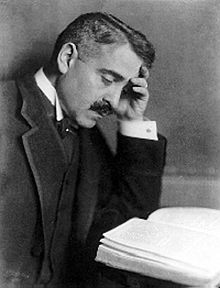
Our 21st-century understanding of the symbolic content of fine art comes from a group of scholars who gathered in Hamburg in the 1920s. The most prominent among them were Erwin Panofsky, Aby Warburg, Fritz Saxl and Gertrud Bing. Together they adult much of the vocabulary that continues to be used in the 21st century by fine art historians. "Iconography"—with roots meaning "symbols from writing" refers to subject field matter of art derived from written sources—particularly scripture and mythology. "Iconology" is a broader term that referred to all symbolism, whether derived from a specific text or not. Today art historians sometimes use these terms interchangeably.
Panofsky, in his early work, also adult the theories of Riegl, but became eventually more preoccupied with iconography, and in particular with the transmission of themes related to classical artifact in the Middle Ages and Renaissance. In this respect his interests coincided with those of Warburg, the son of a wealthy family who had assembled an impressive library in Hamburg devoted to the study of the classical tradition in later art and culture. Under Saxl'south auspices, this library was developed into a research plant, affiliated with the University of Hamburg, where Panofsky taught.
Warburg died in 1929, and in the 1930s Saxl and Panofsky, both Jewish, were forced to leave Hamburg. Saxl settled in London, bringing Warburg's library with him and establishing the Warburg Institute. Panofsky settled in Princeton at the Constitute for Advanced Study. In this respect they were function of an extraordinary influx of German art historians into the English-speaking academy in the 1930s. These scholars were largely responsible for establishing art history equally a legitimate subject in the English-speaking globe, and the influence of Panofsky'southward methodology, in particular, adamant the form of American art history for a generation.
Freud and psychoanalysis [edit]
Heinrich Wölfflin was not the simply scholar to invoke psychological theories in the study of art. Psychoanalyst Sigmund Freud wrote a book on the artist Leonardo da Vinci, in which he used Leonardo's paintings to interrogate the artist'south psyche and sexual orientation. Freud inferred from his analysis that Leonardo was probably homosexual.

Though the use of posthumous textile to perform psychoanalysis is controversial amidst art historians, especially since the sexual mores of Leonardo's time and Freud's are different, information technology is often attempted. One of the best-known psychoanalytic scholars is Laurie Schneider Adams, who wrote a pop textbook, Art Beyond Time, and a volume Art and Psychoanalysis.
An unsuspecting plough for the history of art criticism came in 1914 when Sigmund Freud published a psychoanalytical interpretation of Michelangelo'south Moses titled Der Moses des Michelangelo as ane of the first psychology based analyses on a work of art.[11] Freud starting time published this work before long after reading Vasari's Lives. For unknown purposes, Freud originally published the article anonymously.
Jung and archetypes [edit]
Carl Jung also applied psychoanalytic theory to art. C.Chiliad. Jung was a Swiss psychiatrist, an influential thinker, and founder of analytical psychology. Jung's approach to psychology emphasized understanding the psyche through exploring the worlds of dreams, art, mythology, world faith and philosophy. Much of his life'southward work was spent exploring Eastern and Western philosophy, alchemy, astrology, sociology, likewise as literature and the arts. His well-nigh notable contributions include his concept of the psychological archetype, the collective unconscious, and his theory of synchronicity. Jung believed that many experiences perceived as coincidence were not merely due to run a risk merely, instead, suggested the manifestation of parallel events or circumstances reflecting this governing dynamic.[12] He argued that a collective unconscious and archetypal imagery were detectable in art. His ideas were particularly popular amid American Abstruse expressionists in the 1940s and 1950s.[13] His work inspired the surrealist concept of drawing imagery from dreams and the unconscious.
Jung emphasized the importance of balance and harmony. He cautioned that modernistic humans rely too heavily on science and logic and would benefit from integrating spirituality and appreciation of the unconscious realm. His work non only triggered analytical piece of work by art historians, but information technology became an integral role of art-making. Jackson Pollock, for example, famously created a series of drawings to back-trail his psychoanalytic sessions with his Jungian psychoanalyst, Dr. Joseph Henderson. Henderson who later published the drawings in a text devoted to Pollock'south sessions realized how powerful the drawings were as a therapeutic tool.[xiv]
The legacy of psychoanalysis in fine art history has been profound, and extends beyond Freud and Jung. The prominent feminist art historian Griselda Pollock, for example, draws upon psychoanalysis both in her reading into gimmicky art and in her rereading of modernist art. With Griselda Pollock's reading of French feminist psychoanalysis and in particular the writings of Julia Kristeva and Bracha Fifty. Ettinger, as with Rosalind Krauss readings of Jacques Lacan and Jean-François Lyotard and Catherine de Zegher's curatorial rereading of fine art, Feminist theory written in the fields of French feminism and Psychoanalysis has strongly informed the reframing of both men and women artists in art history.
Marx and credo [edit]
During the mid-20th century, art historians embraced social history by using critical approaches. The goal was to show how art interacts with power structures in society. One disquisitional approach that art historians[ who? ] used was Marxism. Marxist art history attempted to show how art was tied to specific classes, how images comprise data almost the economy, and how images can brand the status quo seem natural (ideology).[ citation needed ]
Marcel Duchamp and Dada Motility spring started the Anti-art style. Various creative person did non want to create artwork that everyone was befitting to at the time. These two movements helped other artist to create pieces that were not viewed as traditional art. Some examples of styles that branched off the anti-art movement would exist Neo-Dadaism, Surrealism, and Constructivism. These styles and artist did not want to surrender to traditional ways of art. This way of thinking provoked political movements such as the Russian Revolution and the communist ideals.[fifteen]
Artist Isaak Brodsky piece of work of art 'Shock-worker from Dneprstroi' in 1932 shows his political interest inside art. This piece of art can be analysed to show the internal troubles Soviet Russia was experiencing at the fourth dimension. Perhaps the best-known Marxist was Clement Greenberg, who came to prominence during the late 1930s with his essay "Avant-garde and Kitsch".[sixteen] In the essay Greenberg claimed that the avant-garde arose in social club to defend aesthetic standards from the pass up of taste involved in consumer society, and seeing kitsch and art as opposites. Greenberg further claimed that advanced and Modernist art was a means to resist the leveling of civilisation produced by capitalist propaganda. Greenberg appropriated the German language word 'kitsch' to describe this consumerism, although its connotations take since changed to a more affirmative notion of leftover materials of capitalist civilization. Greenberg later[ when? ] became well known for examining the formal backdrop of modern art.[ citation needed ]
Meyer Schapiro is i of the all-time-remembered Marxist art historians of the mid-20th century. Although he wrote virtually numerous time periods and themes in art, he is best remembered for his commentary on sculpture from the late Centre Ages and early on Renaissance, at which time he saw evidence of capitalism emerging and feudalism failing.[ citation needed ]
Arnold Hauser wrote the first Marxist survey of Western Art, entitled The Social History of Fine art. He attempted to show how class consciousness was reflected in major art periods. The book was controversial when published during the 1950s since it makes generalizations about entire eras, a strategy now called "vulgar Marxism".[ commendation needed ]
Marxist Art History was refined in the department of Fine art History at UCLA with scholars such as T.J. Clark, O.K. Werckmeister, David Kunzle, Theodor Westward. Adorno, and Max Horkheimer. T.J. Clark was the kickoff art historian writing from a Marxist perspective to abandon vulgar Marxism. He wrote Marxist fine art histories of several impressionist and realist artists, including Gustave Courbet and Édouard Manet. These books focused closely on the political and economical climates in which the art was created.[17]
Feminist fine art history [edit]
Linda Nochlin'south essay "Why Have There Been No Great Women Artists?" helped to ignite feminist art history during the 1970s and remains one of the most widely read essays about female artists. This was and then followed past a 1972 College Fine art Association Panel, chaired by Nochlin, entitled "Eroticism and the Image of Woman in Nineteenth-Century Art". Within a decade, scores of papers, articles, and essays sustained a growing momentum, fueled by the Second-moving ridge feminist move, of disquisitional discourse surrounding women'due south interactions with the arts as both artists and subjects. In her pioneering essay, Nochlin applies a feminist critical framework to show systematic exclusion of women from art training, arguing that exclusion from practicing art every bit well every bit the canonical history of art was the upshot of cultural conditions which concise and restricted women from art producing fields.[xviii] The few who did succeed were treated every bit anomalies and did not provide a model for subsequent success. Griselda Pollock is some other prominent feminist art historian, whose use of psychoanalytic theory is described above.
While feminist art history can focus on any time period and location, much attention has been given to the Modern era. Some of this scholarship centers on the feminist art motion, which referred specifically to the feel of women. Oftentimes, feminist art history offers a critical "re-reading" of the Western fine art canon, such as Carol Duncan'south re-estimation of Les Demoiselles d'Avignon. 2 pioneers of the field are Mary Garrard and Norma Broude. Their anthologies Feminism and Art History: Questioning the Litany, The Expanding Discourse: Feminism and Art History, and Reclaiming Feminist Agency: Feminist Art History Later on Postmodernism are substantial efforts to bring feminist perspectives into the discourse of art history. The pair also co-founded the Feminist Art History Conference.[19]
Barthes and semiotics [edit]
As opposed to iconography which seeks to identify meaning, semiotics is concerned with how meaning is created. Roland Barthes's connoted and denoted meanings are paramount to this exam. In whatsoever particular work of art, an interpretation depends on the identification of denoted meaning[20]—the recognition of a visual sign, and the connoted pregnant[21]—the instant cultural associations that come up with recognition. The main concern of the semiotic art historian is to come up with ways to navigate and interpret connoted pregnant.[22]
Semiotic fine art history seeks to uncover the codification meaning or meanings in an aesthetic object past examining its connection to a commonage consciousness.[23] Fine art historians practice not commonly commit to any ane detail brand of semiotics but rather construct an confederate version which they incorporate into their collection of analytical tools. For example, Meyer Schapiro borrowed Saussure's differential significant in effort to read signs as they exist inside a system.[24] Co-ordinate to Schapiro, to understand the meaning of frontality in a specific pictorial context, information technology must be differentiated from, or viewed in relation to, alternate possibilities such every bit a profile, or a 3-quarter view. Schapiro combined this method with the work of Charles Sanders Peirce whose object, sign, and interpretant provided a construction for his approach. Alex Potts demonstrates the application of Peirce'due south concepts to visual representation by examining them in relation to the Mona Lisa. By seeing the Mona Lisa, for example, as something across its materiality is to identify it as a sign. It is then recognized every bit referring to an object outside of itself, a woman, or Mona Lisa. The image does non seem to denote religious meaning and can therefore exist assumed to be a portrait. This interpretation leads to a concatenation of possible interpretations: who was the sitter in relation to Leonardo da Vinci? What significance did she have to him? Or, mayhap she is an icon for all of womankind. This concatenation of interpretation, or "unlimited semiosis" is endless; the art historian's task is to identify boundaries on possible interpretations as much every bit it is to reveal new possibilities.[25]
Semiotics operates nether the theory that an image tin can merely be understood from the viewer'due south perspective. The creative person is supplanted past the viewer as the purveyor of meaning, even to the extent that an estimation is still valid regardless of whether the creator had intended information technology.[25] Rosalind Krauss espoused this concept in her essay "In the Proper noun of Picasso." She denounced the artist's monopoly on meaning and insisted that pregnant tin can merely be derived after the work has been removed from its historical and social context. Mieke Bal argued similarly that significant does non even be until the paradigm is observed by the viewer. Information technology is merely afterwards acknowledging this that significant tin can become opened up to other possibilities such equally feminism or psychoanalysis.[26]
Museum studies and collecting [edit]
Aspects of the subject area which have come to the fore in recent decades include interest in the patronage and consumption of art, including the economics of the art market place, the function of collectors, the intentions and aspirations of those commissioning works, and the reactions of contemporary and later viewers and owners. Museum studies, including the history of museum collecting and brandish, is now a specialized field of study, as is the history of collecting.
New materialism [edit]
Scientific advances have made possible much more accurate investigation of the materials and techniques used to create works, peculiarly infra-blood-red and x-ray photographic techniques which take allowed many underdrawings of paintings to be seen once again. Proper analysis of pigments used in pigment is now possible, which has upset many attributions. Dendrochronology for panel paintings and radio-carbon dating for former objects in organic materials have allowed scientific methods of dating objects to confirm or upset dates derived from stylistic analysis or documentary evidence. The development of good color photography, now held digitally and available on the cyberspace or past other ways, has transformed the study of many types of art, peculiarly those covering objects existing in big numbers which are widely dispersed among collections, such as illuminated manuscripts and Persian miniatures, and many types of archaeological artworks.
Concurrent to those technological advances, fine art historians have shown increasing interest in new theoretical approaches to the nature of artworks equally objects. Affair theory, actor–network theory, and object-oriented ontology accept played an increasing role in art historical literature.
Nationalist art history [edit]
The making of fine art, the academic history of art, and the history of fine art museums are closely intertwined with the rise of nationalism. Art created in the mod era, in fact, has ofttimes been an effort to generate feelings of national superiority or love of 1's country. Russian fine art is an peculiarly expert example of this, as the Russian avant-garde and later Soviet art were attempts to define that land'south identity.
Most art historians working today identify their specialty as the art of a particular culture and time menses, and frequently such cultures are also nations. For example, someone might specialize in the 19th-century German or contemporary Chinese art history. A focus on nationhood has deep roots in the discipline. Indeed, Vasari's Lives of the Most Excellent Painters, Sculptors, and Architects is an attempt to show the superiority of Florentine artistic culture, and Heinrich Wölfflin's writings (specially his monograph on Albrecht Dürer) attempt to distinguish Italian from German styles of art.
Many of the largest and nigh well-funded art museums of the world, such every bit the Louvre, the Victoria and Albert Museum, and the National Gallery of Art in Washington are state-owned. Nearly countries, indeed, have a national gallery, with an explicit mission of preserving the cultural patrimony endemic by the authorities—regardless of what cultures created the fine art—and an often implicit mission to bolster that land'due south own cultural heritage. The National Gallery of Art thus showcases art fabricated in the United States, but also owns objects from across the globe.
Divisions by menses [edit]
The bailiwick of fine art history is traditionally divided into specializations or concentrations based on eras and regions, with further sub-partitioning based on media. Thus, someone might specialize in "19th-century German compages" or in "16th-century Tuscan sculpture." Sub-fields are ofttimes included nether a specialization. For example, the Aboriginal Near E, Greece, Rome, and Arab republic of egypt are all typically considered special concentrations of Ancient fine art. In some cases, these specializations may be closely allied (as Greece and Rome, for instance), while in others such alliances are far less natural (Indian fine art versus Korean art, for case).
Non-Western or global perspectives on art have go increasingly predominant in the art historical canon since the 1980s.
"Contemporary art history" refers to research into the period from the 1960s until today reflecting the break from the assumptions of modernism brought by artists of the neo-avant-garde[27] and a continuity in contemporary art in terms of practice based on conceptualist and post-conceptualist practices.
Professional organizations [edit]
In the United States, the about important art history organization is the College Art Association.[28] It organizes an almanac conference and publishes the Art Bulletin and Art Periodical. Like organizations exist in other parts of the world, too equally for specializations, such as architectural history and Renaissance art history. In the UK, for example, the Clan of Art Historians is the premiere arrangement, and it publishes a journal titled Fine art History.[29]
Encounter too [edit]
- Aesthetics
- Art criticism
- Bildwissenschaft
- Fine Arts
- History of art
- Rock art studies
- Visual arts and Theosophy
- Women in the art history field
Notes and references [edit]
- ^ "Art History [ permanent expressionless link ] ". WordNet Search - 3.0, princeton.edu
- ^ "What is art history and where is information technology going? (article)". Khan Academy . Retrieved 2020-04-19 .
- ^ "What is the History of Art? | History Today". world wide web.historytoday.com . Retrieved 2017-06-23 .
- ^ Cf: 'Art History versus Aesthetics', ed. James Elkins (New York: Routledge, 2006).
- ^ Get-go English Translation retrieved January 25, 2010
- ^ Dictionary of Art Historians Retrieved January 25, 2010
- ^ The shorter Columbia album of traditional Chinese literature, Past Victor H. Mair, p.51 retrieved January 25, 2010
- ^ Artnet artist biographies retrieved Jan 25, 2010
- ^ website created by Adrienne DeAngelis, currently incomplete, intended to be unabridged, in English language. Archived 2010-12-05 at the Wayback Machine retrieved January 25, 2010
- ^ Chilvers, Ian (2005). The Oxford lexicon of art (3rd ed.). [Oxford]: Oxford University Press. ISBN0198604769.
- ^ Sigmund Freud. The Moses of Michelangelo The Standard Edition of the Complete Psychological Works of Sigmund Freud. Translated from the German under the general editorship of James Strachey in collaboration with Anna Freud, assisted past Alix Strachey and Alan Tyson. Volume XIII (1913-1914): Totem And Taboo and other Works. London. The Hogarth Press and The Institute Of Psycho-Analysis. 1st Edition, 1955.
- ^ In Synchronicity in the terminal two pages of the Determination, Jung stated that non all coincidences are meaningful and further explained the creative causes of this phenomenon.
- ^ Jung defined the collective unconscious as alike to instincts in Archetypes and the Collective Unconscious.
- ^ Jackson Pollock An American Saga, Steven Naismith and Gregory White Smith, Clarkson N. Potter publ. copyright 1989,Archetypes and Alchemy pp. 327-338. ISBN 0-517-56084-4
- ^ Gayford, Martin (xviii February 2017). "Exhibitions: Revolution - Russian Art 1917-1932". The Spectator. Retrieved 29 October 2018.
- ^ Clement Greenberg, Fine art and Culture, Beacon Printing, 1961
- ^ Clark, "Preliminaries to a Possible Reading of Manet'south Olympia," Screen 21.1 (1980): xviii-42.
- ^ Nochlin, Linda (January 1971). "Why Have There Been No Great Women Artists?". ARTnews.
- ^ wpengine (2019-09-02). "Feminist Art History Conference 2020 at American University". Art Herstory . Retrieved 2021-02-eighteen .
- ^ "Definition of denote | Lexicon.com". www.dictionary.com . Retrieved 2021-02-18 .
- ^ "Definition of connote | Dictionary.com". www.dictionary.com . Retrieved 2021-02-18 .
- ^ All ideas in this paragraph reference A. Potts, 'Sign', in R.S. Nelson and R. Shiff, Critical Terms for Art History 2nd edn (Chicago 2003) pp. 31."
- ^ "S. Bann, 'Meaning/Interpretation', in R.S. Nelson and R. Shiff, Critical Terms for Art History 2nd edn (Chicago 2003) pp. 128."
- ^ "M. Hatt and C. Klonk, Art History: A Critical Introduction to its Methods (Manchester 2006) pp. 213."
- ^ a b "A. Potts, 'Sign', in R.S. Nelson and R. Shiff, Critical Terms for Art History 2nd edn (Chicago 2003) pp. 24."
- ^ "M. Hatt and C. Klonk, Art History: A Critical Introduction to its Methods (Manchester 2006) pp. 205-208."
- ^ "Neo avant-garde - The Art and Popular Civilisation Encyclopedia". www.artandpopularculture.com . Retrieved 2021-02-eighteen .
- ^ Higher Art Association
- ^ Association of Art Historians Webpage
Farther reading [edit]
- Listed by appointment
- Wölfflin, H. (1915, trans. 1932). Principles of fine art history; the problem of the development of style in later art. [New York]: Dover Publications.
- Hauser, A. (1959). The philosophy of art history. New York: Knopf.
- Arntzen, East., & Rainwater, R. (1980). Guide to the literature of art history. Chicago: American Library Clan.
- Holly, M. A. (1984). Panofsky and the foundations of art history. Ithaca, N.Y.: Cornell Academy Printing.
- Johnson, Westward. M. (1988). Art history: its employ and corruption. Toronto: University of Toronto Printing.
- Carrier, D. (1991). Principles of art history writing. University Park, Pa: Pennsylvania State University Press.
- Kemal, Salim, and Ivan Gaskell (1991). The Language of Art History. Cambridge Academy Press. ISBN 0-521-44598-i
- Fitzpatrick, V. L. N. V. D. (1992). Art history: a contextual inquiry class. Point of view series. Reston, VA: National Fine art Education Association.
- Modest, Vernon Hyde. (1994). Critical Theory of Art History. Englewood Cliffs, NJ: Prentice Hall.
- Nelson, R. Due south., & Shiff, R. (1996). Disquisitional terms for fine art history. Chicago: University of Chicago Press.
- Adams, L. (1996). The methodologies of art: an introduction. New York, NY: IconEditions.
- Frazier, North. (1999). The Penguin concise dictionary of art history. New York: Penguin Reference.
- Pollock, G., (1999). Differencing the Canon. Routledge. ISBN 0-415-06700-vi
- Harrison, Charles, Paul Wood, and Jason Gaiger. (2000). Art in Theory 1648-1815: An Anthology of Irresolute Ideas. Malden, MA: Blackwell.
- Minor, Vernon Hyde. (2001). Art history's history. 2nd ed. Upper Saddle River, NJ: Prentice Hall.
- Robinson, Hilary. (2001). Feminism-Fine art-Theory: An Anthology, 1968–2000. Malden, MA: Blackwell.
- Clark, T.J. (2001). Farewell to an Idea: Episodes from a History of Modernism. New Haven: Yale University Press.
- Buchloh, Benjamin. (2001). Neo-Avantgarde and Civilisation Manufacture. Cambridge, MA: MIT Press.
- Mansfield, Elizabeth (2002). Art History and Its Institutions: Foundations of a Subject field. Routledge. ISBN 0-415-22868-9
- Murray, Chris. (2003). Key Writers on Art. 2 vols, Routledge Fundamental Guides. London: Routledge.
- Harrison, Charles, and Paul Wood. (2003). Art in Theory, 1900–2000: An Anthology of Changing Ideas. 2nd ed. Malden, MA: Blackwell.
- Shiner, Larry. (2003). The Invention of Art: A Cultural History. Chicago: Academy of Chicago Printing. ISBN 978-0-226-75342-3
- Pollock, Griselda (ed.) (2006). Psychoanalysis and the Paradigm. Oxford: Blackwell. ISBN one-4051-3461-five
- Emison, Patricia (2008). The Shaping of Fine art History. University Park: The Pennsylvania Land University Press. ISBN 978-0-271-03306-8
- Charlene Spretnak (2014), The Spiritual Dynamic in Mod Art : Fine art History Reconsidered, 1800 to the Present.
- Gauvin Alexander Bailey (2014) The Spiritual Rococo: Décor and Divinity from the Salons of Paris to the Missions of Patagonia. Farnham: Ashgate.
External links [edit]
 | Look up art history in Wiktionary, the free dictionary. |
-
 Media related to Fine art history at Wikimedia Eatables
- Art History Resources on the Web in-depth directory of web links, divided by menstruation
- Dictionary of Art Historians, a database of notable art historians maintained past Duke Academy
- Rhode Island College LibGuide - Fine art and Art History Resources
Source: https://en.wikipedia.org/wiki/Art_history

Post a Comment for "Study Shows Costs of Living for Working Families Leveling Off in Pa"